
LaSalle Projected Versus Actual Release
A projected date is the result of a current calculation, not a promise that a gate-out event will occur that day. IDOC may revise an estimate when it receives sentence information, awards or removes credit, resolves sentence structure, or responds to a new order. The actual prison-exit event occurs only when the authority completes release and no other custody barrier controls.
Three dates are often confused. A Parole Date can mark release from prison into parole or mandatory supervised release. A Projected Discharge Date generally anticipates the end of IDOC control. An actual county-jail release time belongs to the jail record. None should be silently substituted for another.
A pretrial detainee at LaSalle County Jail has no fixed sentence end. The judge's pretrial decision, a dismissal, a later order, or another lawful event may authorize release. A warrant or detainer may prevent community release even after one case changes. The court order establishes legal authority, while the jail record documents the physical custody event.
Find a LaSalle County Release Date
Start by deciding whether the person is in the county jail or in IDOC custody. Sheridan Correctional Center is inside LaSalle County, but it is a state prison. Its dates come from the statewide IDOC trail, not the sheriff's recent-release portal.
- Identify the holding authority and confirm the person with name, birth date, booking data, IDOC number, or case information.
- For IDOC, search by last name, IDOC number, or birth date and open the correct public profile.
- Copy Offender Status, Location, Parole Date, Projected Discharge Date, and each judgment and sentence row.
- For LaSalle County Jail, obtain the current court sentencing or release order.
- Ask the jail records officer for the present calculation and any public booking or release record.
- Check for another case, warrant, detainer, transfer, or consecutive term before treating a date as community release.
- For formal state proof, use IDOC FOIA or the archive route after the profile disappears.
The LaSalle County release-record guide covers the named-person search and county FOIA path in more detail. Current-roster absence is not enough. A person may have transferred to IDOC, another county, or another authority rather than entered the community.
IDOC Fields Behind Projected Release
The official IDOC search wrapper directs users to the public Individual in Custody Search used for state prisoners and some supervised people.
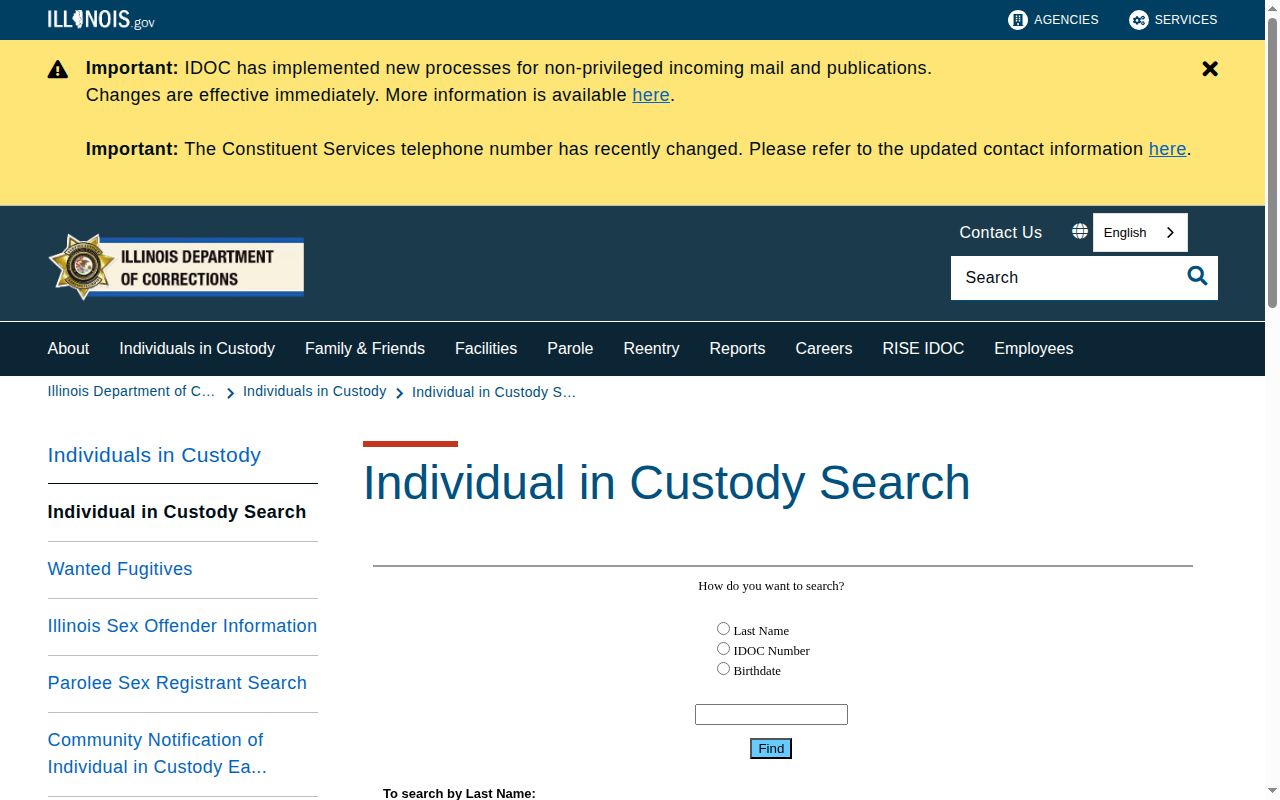
This statewide tool applies to Sheridan Correctional Center and other IDOC institutions, not to the LaSalle County Jail roster.
| IDOC field | How to read it |
|---|---|
| Offender Status | Shows the current published status, such as custody or supervised release. |
| Location | May identify an institution or parole district and helps explain the status. |
| Parole Date | Can support prison exit into parole or MSR when read with status and location. |
| Projected Discharge Date | Usually anticipates the end of IDOC control, not the prison-exit day. |
| Judgment and sentence rows | Show the terms that must be read together, including discharge indicators. |
IDOC's FAQ says an Earned Sentence Credit award that revises a projected parole date appears in the profile. That reinforces why the live profile is a current estimate rather than a fixed promise. Record the access date and preserve the exact field name.
Illinois Sentence Credit Rules
Illinois sentence-credit law is 730 ILCS 5/3-6-3. It is specific to the offense, offense date, sentence structure, statutory version, and person's eligibility. There is no sound one-rate calculator for every Illinois sentence.
Under subsection (a)(2.1), qualifying sentences outside enumerated limits may receive one day of sentence credit for each day of imprisonment or recommitment. Subsection (a)(2) sets tighter rules for specified serious offenses. The phrase “85 percent rule” commonly describes the maximum 4.5 credit days per month for enumerated offenses, but it does not apply to everyone. Some listed drug offenses use a 7.5-days-per-month framework often described as 75 percent, while some terms require 100 percent service.
Subsection (a)(4.7) permits certain program or educational credits in restricted categories while retaining statutory floors. The research identifies floors of at least 85 percent for people otherwise in the 85-percent group, 60 percent for certain people otherwise in a 75-percent category while gunrunning remains at 75 percent, and 100 percent where full service is required.
Other provisions address successful programming, qualifying presentence programming, rule compliance, service, and education. Examples in the research include 90 days for a qualifying high-school-equivalency achievement, 120 days for an associate degree, and 180 days for a bachelor's degree, all subject to restrictions. Credit may be unavailable, withheld, lost, restored, or awarded later. Those possibilities explain movement in a projected date; they do not guarantee credit in a specific case.
Note: Never apply a general 85-percent claim without checking the conviction, offense date, governing statute, sentence terms, and current IDOC calculation.
What Changes LaSalle Release Dates
A date can move for legal, administrative, or custody reasons. The change should be traced to a source rather than guessed from a prior profile.
| Factor | Possible effect |
|---|---|
| Mittimus correction | New or corrected commitment data can change the sentence calculation. |
| Court or appellate order | An amended judgment or reviewing-court action can alter custody authority. |
| Consecutive terms | Sentence rows may combine differently than a single displayed term suggests. |
| Earned credit | A new award may move the projected prison-exit date earlier. |
| Discipline or credit loss | Withheld or revoked credit can move the calculation later. |
| Parole or MSR violation | Recustody and PRB action can send the case to IDOC for recalculation. |
| Warrant or detainer | Release from one authority may become transfer to another rather than freedom. |
| Clerical correction | An agency can correct a data or calculation error. |
Parole eligibility is separately governed by 730 ILCS 5/3-3-3. Legacy indeterminate cases can involve a Prisoner Review Board decision. People sentenced under the modern determinate system generally serve the term less lawful credit and then enter MSR rather than receiving an ordinary discretionary parole vote. A hearing date or grant is not the physical release event.
County Jail Calculations Need Court Records
Do not apply the state-prison profile formula mechanically to a LaSalle County Jail sentence. The correct calculation may depend on the actual court sentence, presentence custody credit, applicable jail credit rule, concurrent or consecutive structure, and every hold. The research found no official LaSalle public calculator and no verified county weekend-advance policy.
The Circuit Clerk docket can show orders, disposition, and sentence information as entered. It may not show the precise gate-out time. Ask the jail records officer for the present custody calculation and the completed release record when the event has occurred. If a person appears in the county's combined 24-hour or 72-hour intake/release view, verify that the item is a release rather than an intake.
Transfer language matters. A person moved from the jail to Sheridan or another IDOC institution has left county custody but has not been released to the community. Likewise, a handoff on another jurisdiction's warrant is a new custody placement. State the authority on both sides of the event.
Sheridan Dates Follow the IDOC Trail
Sheridan Correctional Center is a medium-security IDOC prison in LaSalle County. Its released-person trail is wholly different from the county jail trail. A supervised person may remain in the public IDOC search with PAROLE status, a Parole Date, a parole location, and a Projected Discharge Date.
The IDOC FAQ and archive guidance explains that information can disappear from the live locator after all sentences are completed.
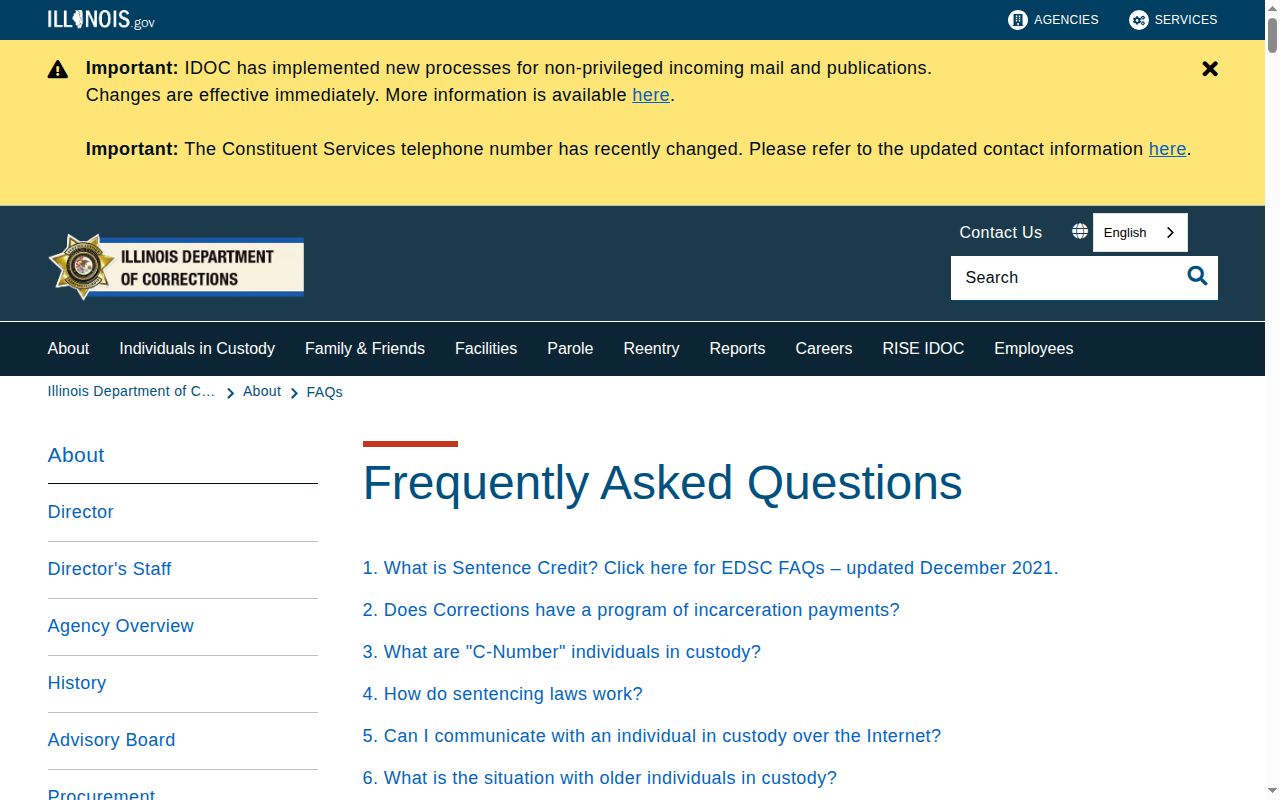
This archive route preserves the distinction between a live supervised profile and a former record that is no longer published in the locator.
An archive request is stronger with the full name, birth date, approximate year IDOC received the person, facility, conviction county, and incarceration dates. For a formal current record, IDOC FOIA is another route. Do not interpret profile disappearance as proof that no imprisonment or release occurred.
Confirm the Actual Release Event
A projected date should be paired with an event-notification plan and a documentary check. Registering through VINELink Inmate Search can provide an alert when the reporting agency sends a selected custody event. After the alert, reopen the agency profile and contact the reporting office.
For IDOC, compare status, location, Parole Date, Projected Discharge Date, and all sentence rows. For LaSalle County Jail, compare the judge's order with the jail event. If another hold exists, the event may be a transfer. If the records conflict, preserve the wording and update times and ask the originating office to explain the difference.